
Inviting Submissions
Upcoming Workshops

Pratidhwani presents a companion performance to Seattle Asian Art Museum's exhibit: "Suchitra Mattai: she walked in reverse and found their songs"
On Saturday, July 19th, and 3:00PM.
At Seattle Asian Art Museum, in Volunteer Park, 1400 E Prospect Street, Seattle.
Directed by Divya Rajan and presented by Pratidhwani, The Fabric of Your Being is a multi-textural, vibrant exploration of how stories of movement and migration are woven together to create unique and complex communities and experiences. Created out of a wide array of written works, including short stories, articles, and prose, The Fabric of Your Being offers a one-of-a-kind performance that begs audiences to reflect on deeper questions of self, community, and identity.
Featuring: Jayant Bhopatkar, Mrinalini, Sandhya Nathan, and Swarnim Vyas.
Costume design by Neha Dimri.
Writing includes:
Fish of Dignity, by Vandana Nair
My Paati's Saris by Jyoti Rajan Gopal
Kerala Sari by Shweta Ganesh Kumar
... and more!
Fabric holds many meanings, literally and metaphorically!
Garments, accessories, sentimental heirlooms
Memories so sacred, and stories fondly nostalgic
Fabrics are known for being sturdy, hardy and resilient through time and use.
Fabrics are also known to be precious and delicate, needing to be preserved with utmost care.
Against the backdrop of all that is unfolding globally, why does the fabric of our being matter now, more than ever?
How do we preserve the threads of our cultural heritage?
What does it mean to keep alive our ancestral heir“looms”?
Join us from 3-4 pm as we reflect on how we weave the Fabric of Our Beings!
Tickets
Free with admission to the museum. Click here for Seattle Asian Art Museum
One of the pieces included in this performance, Fish of Dignity by Vandana Nair is included below, for your reading pleasure.
Fish of Dignity- As Performed on July 19th
“I am not a slave of hope, I am a devotee of patience.” –Ghalib.
Long before sunrise, Rahila Begum arrives at her workshop in the chaotic maze-of -lanes of
busy Chowk. She walks comfortably in the narrow lane, too slim to allow even two people to walk
together, to reach her corner-side 650 sqft. workshop. On the jute sack slung over her shoulder, she
carries an ivory muslin chikankari sari she has finished embroidering with minute, continuous white
floral motifs the night before. By the time the first rays of sunlight skim the thousands-of-bricked
shops spread over the bhoolbhulaiya that is the ancient Chowk market in Lucknow, Rahila’s deft
fingers are already working on the Murri-embroidery work on the blouse-piece that will
complement the finished Chikankari saree. In this oldest market in Lucknow, exquisite white-on-
white embroidery and brown women with needles are predominant: delicate, nimble, skilled fingers
desired for both.
I met Rahila Begum for the first time when we were both young girls of fifteen, born and raised
in Lucknow—a medieval town along the banks of the River Gomti, a city of horse-driven carriages,
boats and alien travellers, which had blossomed for a hundred years under the Nawabs. On the brink
of graduating from high school in 1985, I was collecting data for my Economics project on
the Chikankari industry while Rahila was already earning her keep. Her mother supervised the tiny
650 sqft. shop in Chowk that had belonged to her husband’s family and had been handed down
generations. While Rahila’s father was the true inheritor of the workshop, by exercising the freedom
that came with his gender, he had moved to the far more lucrative profession of butchery. He left the
workshop to his far more talented wife, who passed her time embroidering flowers and
paisleys. Rahila’s mother, being an unpaid supervisor herself, further employed an underpaid feminine workforce to keep the family craftsmanship alive. In the bylanes of Lucknow Chowk, the
ancient order of “a potter bringing up his child to be a potter; a jeweller training his child to be
a jeweller; and an embroiderer raising his child to be an embroiderer” rigidly persisted, which also
meant craftswomen marrying within their trade and professions to keep their skill and craft
sacrosanct. In this way, Rahila, too, had inherited this poorly paid apprenticeship of being
a Chikankari embroiderer by virtue of her birth.
When I met her, Rahila was learning the “Bakhiya”, or shadow stitch, where she embroidered
motifs and fillers on the wrong side of the fabric in a running stitch pattern that created a shadow or
double-outline effect on the front side of the garment. I remembered reading a book called Chikan
Embroidery: the Floral Whitework of India by Sheila Paine for my project, in which she discusses
the etymology of the word “chikan,” a Persian word. According to Paine, “Chikankari,” the Indian
word could be dissected as “chikan”, loosely meaning needle in Persian, and “Kari”, the Hindi name
for work. Rahila used small square scrap handkerchiefs for her practice, whose backs she slowly
filled with designs, resulting in a fine shadow on the face of the fabric, without revealing a single
crease of concern on her face. To my unskilled, rookie eyes, when I saw Rahila doing the shadow-
work it felt nothing short of an art form, and not the simplistic “needle-work” Paine defined in her
book!
“Now, I am getting better at doing “Janira,”—a fundamental herringbone stitch in Chikankari—as
she explained to me one day during that two-week project stint. As I observed Rahila’s work day
after day, she symbolised adaptability and flexibility, similar to the herringbone pattern she was
trying to master resembling the spine of a fish, which she said would bring her good luck and
prosperity. Paid one rupee a week, Rahila’s weekly wage became data for my project.
“Once my fingers know better finishing, Ammi will let me do the neckline of a kurta. Then I will
earn an additional 10 paisa per kurta,” she confided in me, eyes shining at the expectations of a
raise.
“Is that the first stitch you learned,” I asked her, “the shadow work?” I asked about the inverted
damask stitch or Bakhiya, as she skillfully filled up on the background of the square patches of
ivory cloth she would hem later into tiny handkerchiefs.
“No, no,” she said. “I started with the Taiphchi.” She left her work for a moment to get up and find a
yellow square piece from a corner side cupboard, which had simple petal-shaped motifs that looked
like they were bees or beetles scattered in a vast field of mustard.
“They look like patches used to repair a cloth?” I spoke about the running stitch. She nodded.
“In a way, they are,” she said, “that’s the first stitch we learn, used for darning and covering
mistakes to create a weave.”
“Then?”
“Then Murri, in which I can make tear-drop shaped knots; Bakhiya, which I am doing now that is
inverted satin-stitch; Phanda, in which I learn to make tiny spherical knots, and finally Jali, which is
the hardest because I need to make tiny button-holes or blanket stitch, which will hold a fishing
net,” she counted on her fingers.
“Then?”
“Then I will catch the fish motif in my jaali,” she laughed. She slapped her forehead at my bemused
expression, “Arre ahmaq, I will become a master embroiderer, and Ammi will let me embroider the fish motif!” That she could feel comfortable to call me silly felt like a special step forward in our friendship.

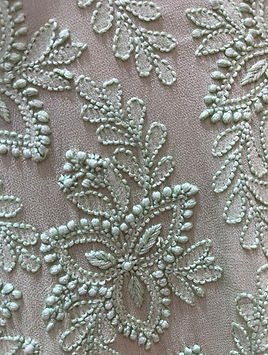
“You seem to really like the fish motif,” I said, looking at her practice scraps in which there were
several imperfect attempts at getting the perfect shape of a fish. Rahila’s obsession for the fish motif
fascinated me. While growing up, we had often heard of the story of how sailing on the Ganges, the
newly-appointed Governor of Awadh, also the first Nawab, had encountered two fishes that leapt up
from the waters and onto his knees and considered them harbingers of his great fortune, representing
bravery and strength. Besides seeing them in chikankari motifs, most Lucknow city inhabitants
could see this motif on a pair of fish symbols atop sturdy architecture marvels built by the Nawabs,
prominently mounted on the round arches of large gateways or darwaazas used to enter these
monuments. Some stories say the mirror-image fierce-looking fish heads mounted on staff leitmotif
originated from “Mahi-ye-Maratib,” or the “Fish of Dignity,” the Mughal military honour with its
roots in Persia.
“The fish motif is my dream. I plan to learn the Jali and the Janira very quickly, so I can get to it
jaldi-jaldi.” She brought down her middle finger to strike the base of her thumb to make a snapping
noise to signify haste. “For my first kurta neckline, I will make fish motifs,” she added, perhaps
already dreaming of what she would do with all that good fortune the fish motifs would bring.
Perhaps, the fish did come alive in Rahila’s dreams, because she sang constantly to it.
“Little fish…
Little fish, will you play hide and seek?
I’ll hide your body in my white malmal pond,
When I turn the water-like muslin on my palm,
I’ll see your shape, your fin, your scales, your charm
Shadowed on the vast white ocean-like waves,
Will you swim to me, when I call your name,
to fill my plate, my bowl, with sheer-kurma, rice and sweets?
When I break my fast, will you dance on my Eid?”
Rahila’s song always ended with hopes for a celebratory feast on Eid, and then her little fingers
danced on the white muslin cloth she was embroidering.
“Don’t you ever have to go to school?” Armed with youthful candour that only teenage friendships
can provide, I once asked her, clearly in awe of how her mind could stitch songs as fast as her
delicate fingers danced on the cloth, when all she ever did was spend time practicing in the
workshop with her needle and thread.
“Ammi said I was bad at school,” she recalled, “I stopped after third grade,” and she raised her three
fingers for emphasis. I couldn’t imagine Rahila being bad at anything.
“My baby sister Salma was born that year and I loved looking after her. Once Salma was five,
Ammi said I better do something useful,” she added. Until that moment, I had thought I was doing
something useful by going to school, and maybe in her mind Rahila was also comparing which one
of us was doing the more useful thing. Then with her stubborn chin jutting out, she went back to her
embroidery.
